June 3, 2026

Established in 1992, Rus Education is a proud reason of many who are currently living their dream and on the way to achieving their goal of becoming a doctor.

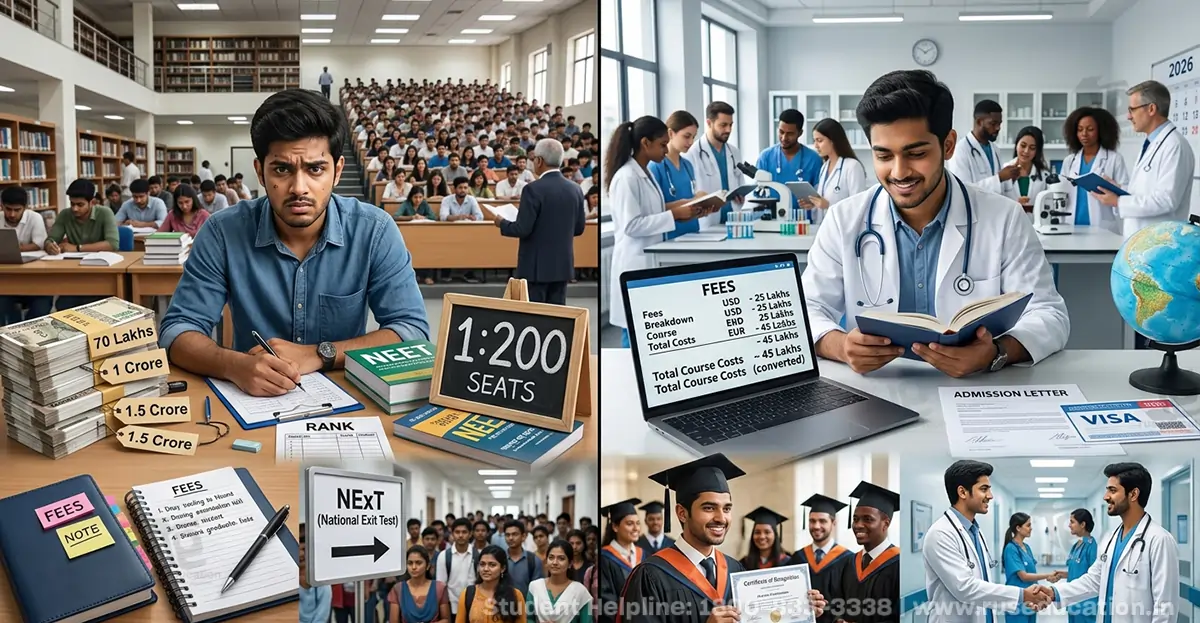
Millions of Indian students dream of becoming doctors every year. They study for NEET with determination, sacrifice social life, and spend years preparing for a single exam. But after the results arrive, many families face a harsh reality. Government MBBS seats remain extremely limited, while private medical college fees in India 2026 continue to rise sharply.
This is exactly where the debate begins: should students choose a private medical college in India or pursue MBBS abroad in 2026?
For many families, this is not just an educational decision. It is an emotional and financial decision that can shape the next 10 years of a student’s life.
In this detailed guide, we will compare Private MBBS vs MBBS abroad in terms of fees, seat availability, career opportunities, licensing, and long-term reality.
Also Read: Most Affordable Medical University in Russia for Indian Students 2026
Competition for MBBS seats in India has become more intense than ever. Over 20 lakh students appear for NEET every year, while government MBBS seats remain limited.
This forces many students into three difficult choices:
For middle-class families, the decision often comes down to affordability and future career security.
The biggest difference between MBBS in India vs MBBS abroad is usually cost.
Government medical colleges in India remain affordable, but getting a seat is extremely difficult due to high cutoffs. On the other hand, private medical colleges can become financially overwhelming for many families.
Meanwhile, several countries offering MBBS abroad for Indian students in 2026 provide medical education at significantly lower costs.
However, fees alone should never decide a student’s future.
Students and parents must also consider:
One of the biggest concerns for parents today is the rapidly increasing private MBBS fees in India.
Depending on the state, quota, and university, the total course cost in private medical colleges can range between ₹50 lakh and ₹1.5 crore or even higher.
Annual tuition fees in deemed and private universities can be extremely high.
Many colleges separately charge hostel, security, transport, and miscellaneous fees.
NRI quota seats are significantly more expensive than management quota seats.
Some institutions include additional yearly charges for clinical training, examinations, and facilities.
This is why many parents searching for medical college fees in India 2026 are shocked after calculating the total 5.5-year expense.
Compared to many Indian private colleges, the MBBS abroad fees 2026 are often much lower.
Countries like Russia, Georgia, Kazakhstan, Uzbekistan, and Kyrgyzstan continue attracting Indian students because of affordable tuition and globally recognised universities.
For many universities abroad, the total MBBS cost, including tuition and hostel, may range between ₹18 lakh and ₹45 lakh, depending on the country and university.
This is one of the biggest reasons why MBBS abroad for Indian students 2026 continues growing every year.
This is where many students emotionally struggle.
Lakhs of students qualify for NEET every year, but government seats remain limited.
Although the National Medical Commission is expanding medical education infrastructure and increasing seat opportunities, competition still remains extremely high.
Even students with decent NEET scores may fail to secure affordable government seats.
As a result, many students either:
This emotional pressure affects both students and parents deeply.
This is the most important section parents must understand carefully.
Students graduating from Indian medical colleges can directly proceed toward internship, licensing, postgraduate preparation, and practice in India.
There is no FMGE requirement for Indian MBBS graduates.
Advantages include:
However, the financial burden can become enormous for families paying very high tuition fees.
Students pursuing MBBS abroad must carefully follow NMC guidelines.
Under current regulations, Indian students studying medicine abroad must meet the Foreign Medical Graduate Licentiate Regulations requirements to practice in India later.
After graduation, students must clear FMGE or future NExT requirements to practice in India.
This is why university selection becomes extremely important.
There is no single “perfect” country for every student.
The best country for MBBS abroad depends on:
However, Russia continues to remain one of the most preferred destinations for Indian students due to:
Countries like Georgia, Kazakhstan, Uzbekistan, and Kyrgyzstan are also gaining popularity among Indian students.
Many parents compare only fees. However, the smarter question they need to ask themselves is: “What value is the student receiving for those fees?”
For instance, a lower-cost college with poor clinical exposure can damage long-term medical skills.
On the other hand, similarly, a very expensive private college does not automatically guarantee better education.
Students must evaluate:
This applies to both Indian and foreign medical universities.
One of the saddest realities in Indian medical education is the emotional burden students carry after NEET.
Many students feel:
Parents often panic after counselling results and make rushed admission decisions.
But medical education is a long journey. One counselling session should not define a student’s entire future.
A thoughtful and informed decision is always better than an emotional one.
Cheap education without proper recognition can create licensing problems later.
Many students fail to verify whether the university follows NMC regulations properly.
Students should always verify:
before taking admission.
Many students lose multiple years hoping for better scores without exploring realistic alternatives.
For many students, yes. But an MBBS abroad is only going to benefit you if you do it right.
MBBS abroad is not a shortcut; it requires discipline and proper planning.
Students who choose recognised universities that follow NMC guidelines and prepare seriously for licensing exams can build successful medical careers.
At the same time, private MBBS in India may remain the better option for families who can comfortably afford the cost and want a direct path within India’s medical system.
The correct choice depends on the student’s situation, finances, career goals, and emotional readiness.
Now that you have a clear understanding of the comprehensive comparison between the Private MBBS vs MBBS abroad, it is time to make a sound decision based on what suits you the best.
It’s all about choosing the option that is financially sustainable and career-safe for the student.
Private medical college fees in India 2026 continue rising, while MBBS abroad fees 2026 remain comparatively affordable in many countries. At the same time, MBBS abroad requires careful university selection and strict compliance with NMC regulations.
Parents should avoid panic-based decisions.
Instead, focus on:
The dream of becoming a doctor is still possible. The path may simply look different for every student.
If you are planning to apply for MBBS abroad in 2026, contact Rus Education for complete guidance and admission assistance.
Q.1 Which is better, MBBS in India or MBBS in abroad?
Answer: Choosing between MBBS in India and MBBS abroad largely depends on a student’s NEET score, family budget, and long-term career plans. Securing a government medical seat in India is always a great opportunity because of its affordability and strong clinical exposure. However, for students unable to get a government seat, pursuing MBBS abroad can often be a smarter and more affordable option than paying extremely high fees or donations at private medical colleges in India.
Q.2 Is it better to be a doctor in India or abroad?
Answer: Working as a doctor abroad often comes with higher salaries and access to advanced medical infrastructure and technology. On the other hand, practising in India offers strong social respect and excellent hands-on clinical exposure due to the large patient load. Financial growth may happen faster abroad because of stronger currencies, but experienced doctors and specialists in India can also build successful and highly rewarding careers over time. This is especially true for private practice.
Q.3 Can a poor person study abroad?
Answer: A student from a financially weak background can absolutely study abroad with proper planning and guidance. Many universities around the world offer affordable tuition fees, scholarships, flexible payment options, and low living costs for international students. In the case of MBBS abroad, countries like Russia, Kazakhstan, and Uzbekistan are popular among Indian students because medical education there is often more affordable than private medical colleges in India. However, students and parents should carefully plan expenses related to tuition and accommodation before making a decision.
Q.4 Is NEET compulsory for FMGE?
Answer: NEET qualification is compulsory for Indian students who want to pursue MBBS abroad and later appear for the FMGE or future licensing exams like NExT in India. According to current NMC regulations, students must qualify for NEET before taking admission to a foreign medical university to remain eligible for medical registration and practice in India later. Without an NEET qualification, a student may face serious difficulties in obtaining eligibility for licensing exams in India.
Q.5 What is MBBS called in the USA?
Answer: In the United States, the medical degree equivalent to MBBS is called MD (Doctor of Medicine). While the name differs, both degrees lead to a career in medicine and clinical practice.