

October 28, 2026

Established in 1992, Rus Education is a proud reason of many who are currently living their dream and on the way to achieving their goal of becoming a doctor.

Studying MBBS in Russia allows Indian students to learn medicine in a different academic and healthcare environment. While some universities offer medical education in English, learning Russian can be equally important when students move from classroom learning to clinical training.
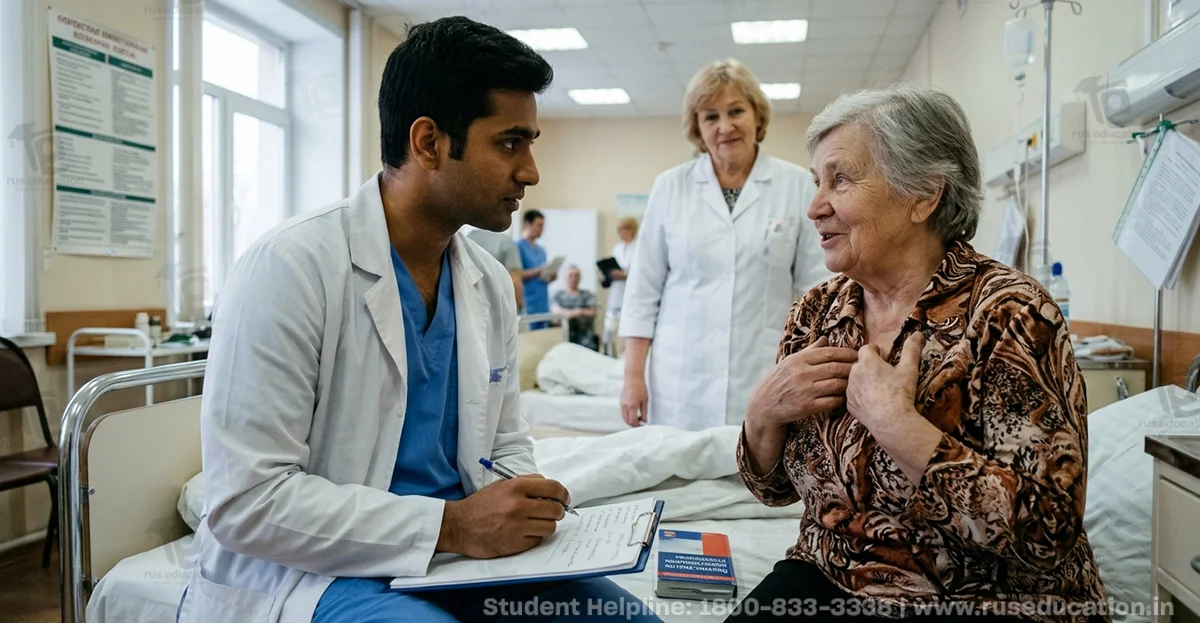
During hospital rotations, students may encounter patients, healthcare professionals, and everyday clinical situations where Russian is commonly spoken. Understanding basic Russian can help students communicate more effectively, follow clinical discussions, and become more familiar with the local healthcare environment.
For Indian students planning to pursue medical education in Russia, learning Russian is not just about adapting to life abroad. It can also be an important part of preparing for clinical training.
In this blog, we explain why Russian language skills matter during clinical training, how students can improve their communication, and what they should know before starting their medical journey in Russia.
English may be the medium of instruction for medical subjects at some Russian universities, but patients in local hospitals may communicate primarily in Russian.
During clinical training, students gradually become familiar with patient interactions, medical examinations, hospital procedures, and discussions with healthcare professionals. Language can influence how comfortably they participate in these activities.
Learning Russian can help students:
The level of Russian required depends on the university, clinical placement, and responsibilities permitted for students. Language skills support learning, but they do not replace clinical supervision or professional interpreting when needed.
Russian language skills can make hospital training easier to navigate. Here are five ways they can help Indian students pursuing MBBS in Russia.
An integral part of clinical training is the comprehension of the patient’s concerns. Patients can report their symptoms, pain, medical history, and discomfort in Russian.
Possessing knowledge of Russian enables students to understand familiar expressions, to ask simple questions for supervised clinical activities, etc.
Students can learn how to ask where a patient is having pain, when the symptoms began or if the patient had similar symptoms before.
Student learning through patient interactions is aided by clear communication. But medical history and clinical decision-making should be conducted with supervision and language support as necessary.
On clinical rotations, students witness doctors in action, participate in discussions, and learn how the various teams in the hospital operate.
There may be some simple directions and discussion in Russian. This will help students to follow these activities more easily if they have some understanding of common words and phrases.
Knowing Russian also allows you to communicate with nurses, doctors and other health care workers more easily.
While MBBS students in Russia learn many subjects in English, further, during the clinical training they may be exposed to Russian medical terminology.
Students will benefit from learning some common Russian medical terms, which will help them identify familiar terms in a hospital and in clinical conversations.
Students can begin with vocabulary related to:
Building this vocabulary gradually can help students connect their theoretical knowledge with the clinical environment.
In clinical training, students learn about doctors’ examinations and discussions with patients, and the ways that doctors handle various clinical situations.
Students who have basic knowledge of Russian may better understand simple conversations and be able to engage in supervised learning activities as permitted.
This is not to say that a person who speaks Russian only is clinically competent. The traditional skills of medicine, manual skills, moral behavior, and advice from experienced physicians are still of great importance.
Students may also gain an understanding of the language that is used in a hospital and medical environment.
A systematic approach to vocabulary building, listening skills development, and familiarity with common clinical interactions allows students to increase their vocabulary, listening skills, and comfort as they move forward in their MBBS course.
This training can be a smoother process, from the classroom to hospital setting.
Yes, it is important to learn Russian even if you study your medical programme in English.
English-medium education enables students to study medical subjects in a familiar language. However, it does not mean that every patient, hospital employee, or clinical supervisor will communicate in English.
The Indian Embassy in Moscow suggests that students intending to pursue medical studies in Russia have to learn Russian for practicing medicine with patients who speak Russian.
The exact language requirements and teaching arrangements vary between universities. Before applying, students should confirm how Russian language classes are included in the curriculum and what level of proficiency is expected during clinical rotations.
The best time to start is during the early years of your MBBS programme. Waiting until clinical rotations begin may make it harder to develop the vocabulary and listening skills needed for clinical communication.
Students can prepare in stages.
| Stage | What to Focus On |
| Before travelling to Russia | Learn greetings, numbers, common questions, and everyday phrases. |
| During the early years | Practise listening, speaking, and basic Russian vocabulary regularly. |
| Before clinical rotations | Learn common medical terms, symptoms, and patient-related questions. |
| During clinical training | Practise communication under supervision and learn from real clinical situations. |
This is a suggested learning approach, not a fixed university curriculum. Students should follow their university’s language classes and clinical training requirements.
Students do not need to learn the entire Russian language at once. Starting with a few everyday words can help them build confidence.
| Russian | Pronunciation | English Meaning |
| Здравствуйте | Zdravstvuyte | Hello |
| Спасибо | Spasibo | Thank you |
| Пожалуйста | Pozhaluysta | Please / You’re welcome |
| Где? | Gde? | Where? |
| Болит? | Bolit? | Does it hurt? |
These are useful starting points for everyday communication. Medical conversations require more detailed language skills, and students should not rely on basic phrases alone when dealing with clinical information.
Learning Russian becomes easier when students practise consistently instead of trying to memorise everything at once.
Here are some practical ways to improve:
Regular practice can help students build confidence over time. The goal is to develop useful communication skills alongside medical knowledge.
Although the Russian language for MBBS students is an important aspect of preparation for MBBS in Russia, the student needs to be aware of the system of medical training and clinical practice at the their chosen university.
Before applying, check the following:
These questions will help you to make a well-informed decision and help you with the preparation process for academic and practical study of Medicine in Russia.
Also read: From Classroom to Hospital: Understanding the MBBS Journey in Russia
Russian Language is an important aspect of preparing for clinical training in Russia during MBBS in Russia. It can assist students from India to communicate with patients, grasp normal hospital interactions, familiarize themselves with the medical vernacular, and adapt to the medical setting in the region.
Even if your programme is taught in English, developing Russian language skills early can make the transition to clinical training easier. Consistent practice, university language classes, and supervised clinical experience can help you improve gradually.
MBBS in Russia is a great choice for those seeking international education, and if you are thinking of pursuing MBBS in Russia, Rus Education can help you understand university options, admission requirements, and the application process so you can prepare for your medical education with greater clarity.
Q1. Do Indian students have to learn Russian while studying MBBS in Russia?
Russian proficiency is required for practical training with Russian-speaking patients. Specific language needs vary from one university to another and from one clinical training program to another.
Q2. Is it possible to study MBBS in Russia without knowledge of Russian?
Some Russian universities offer English-medium medical programmes. However, students have to study Russian for patient contact and practical experience in local hospitals.
Q3. When is the best time to learn Russian in the course of my studies in MBBS in Russia?
It is best to begin before or during the first year. This will allow for continued practice of your everyday communication and medical terminology before clinical rotations.
Q4. Does learning Russian improve clinical training?
Use of the Russian language can enhance the student’s understanding of patient communication and routine hospital communication. However, practical skills and suitable supervision are essential to clinical competence, as is medical knowledge.
Q5. Are there any Russian medical universities that have a curriculum in a different language?
The language classes, the methods of teaching, and clinical training arrangements may vary from university to university. It is important for students to verify the information they get directly with the university of their choice.