June 3, 2026

Established in 1992, Rus Education is a proud reason of many who are currently living their dream and on the way to achieving their goal of becoming a doctor.

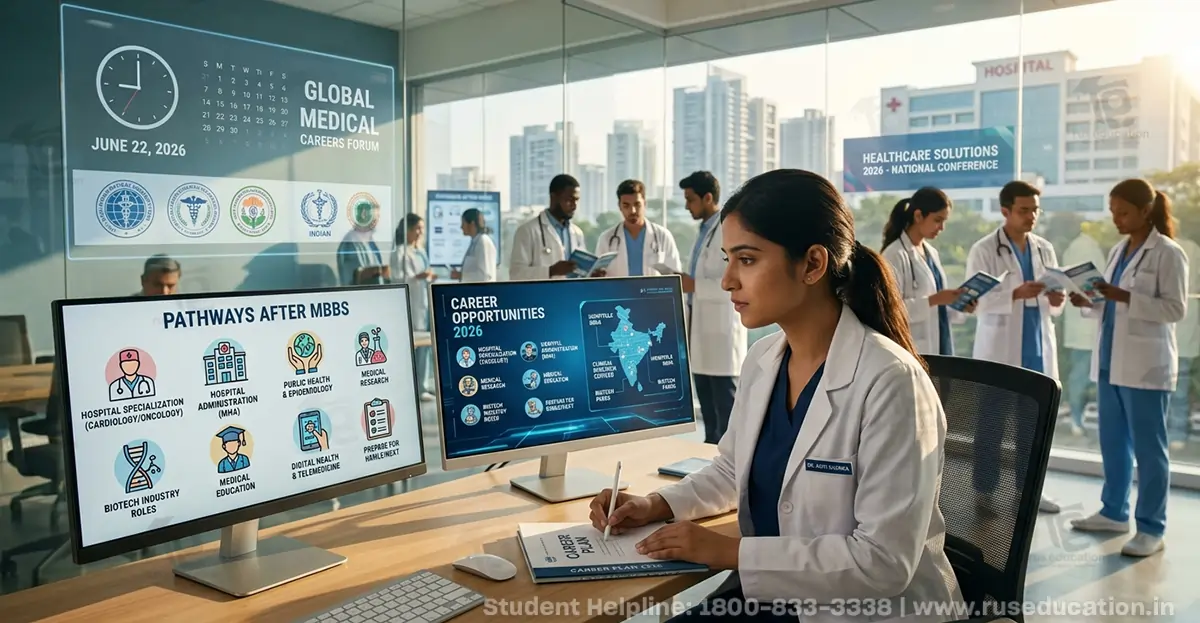
Studying MBBS abroad is no longer just an alternative for Indian students. Now, it has become a serious pathway toward a global medical career. Thousands of Indian students are choosing countries like Russia because of affordable fees and international exposure. But one question still worries many students and parents: “What after that?” The good news is that there is a range of career options after MBBS abroad.
From clinical practice and postgraduate specialisation to healthcare management and medical research, the opportunities are much wider than most students realise. The key is understanding the correct pathway, licensing rules, and future options before starting the journey. Fasten your seatbelts as we dive deep into this comprehensive guide for the career after MBBS abroad for Indian students.
Also Read: Common Admission Mistakes to Avoid for MBBS in Russia
Yes, absolutely. Indian students who complete MBBS abroad can practice in India after fulfilling the regulations laid down by the National Medical Commission (NMC).
As per the Foreign Medical Graduate Licentiate Regulations (FMGL) 2021, students must complete a medical course with a minimum duration of 54 months, undergo a compulsory internship abroad, and qualify for the required screening examination in India.
The FMGE remains a mandatory screening exam for foreign medical graduates who want registration in India. Furthermore, NBEMS continues to conduct the examination in 2026.
For most students, becoming a doctor in India remains the primary goal after MBBS abroad.
Here are the career options after MBBS abroad, once the licensing requirements are completed:
India’s healthcare sector continues to expand rapidly, especially in tier 2 and tier 3 cities, where there is strong demand for qualified doctors.
Many foreign medical graduates also work in multispecialty hospitals while preparing for postgraduate entrance exams.
One of the biggest myths is that MBBS abroad students cannot pursue postgraduate medicine in India.
That is incorrect.
After clearing the required licensing process, foreign medical graduates can appear for postgraduate entrance examinations in India and pursue MD/MS/diploma programs.
Popular specialisations include:
Competition is intense. However, many FMGs successfully secure postgraduate seats every year through dedicated preparation.
Coming to the United Kingdom, it remains one of the most attractive destinations for MBBS graduates from abroad.
International graduates need to clear the PLAB examination pathway to work as a doctor in the UK unless they qualify through another accepted route. The General Medical Council (GMC) confirms that overseas graduates with acceptable qualifications can apply through the PLAB process.
Fortunately, the UK also offers long-term specialisation opportunities through NHS training pathways.
The United States offers one of the most rewarding medical careers for international medical graduates.
However, the process is highly competitive.
Students need to:
According to ECFMG, international medical graduates must meet certification requirements to enter accredited residency programs in the United States.
Many students begin USMLE preparation during their MBBS to improve their residency chances later.
Not every MBBS graduate chooses hospital practice. As of today, healthcare careers are far more diverse than before.
You can also expect the following jobs after MBBS abroad:
Research organisations and pharmaceutical companies actively recruit doctors for clinical studies and healthcare innovation.
Also, many doctors move into hospital management after pursuing healthcare administration courses or MBA programs.
Organisations working in epidemiology, disease prevention, and global healthcare prefer candidates with medical backgrounds.
Medical publications and pharmaceutical brands hire doctors to create accurate medical content.
Moreover, the rise of AI and digital healthcare has created demand for doctors who understand both medicine and technology.
Yes, and many students already do.
A medical degree from abroad can become a stepping stone toward international mobility if students plan strategically from the beginning.
Different countries have different licensing systems, but Indian students today are working in:
What matters most is:
An honest discussion about career options after MBBS abroad must also include the challenges.
Whether it is FMGE, PLAB, or USMLE, students need disciplined preparation.
Choosing a university that does not comply with regulations can create serious issues later.
Recent discussions around FMGL regulations have increased awareness among students regarding internship structures and licensing eligibility.
Furthermore, students should prioritise universities with strong hospital training and patient exposure.
The NMC has also emphasised the importance of hands-on clinical training for foreign medical graduates.
Students who succeed after MBBS abroad usually develop more than academic knowledge.
They often gain:
Living abroad also teaches students how to handle pressure, responsibility, and diverse healthcare environments.
These qualities become valuable during residency applications and job interviews.
Medical education abroad is changing quickly, and students today are far more aware of:
This awareness is actually helping students make smarter decisions.
Also, countries and universities that align with updated regulations are becoming more trusted among Indian students.
The focus has shifted from simply “getting admission” to building a long-term medical career.
That shift matters.
An MBBS degree from abroad can lead to a successful medical career in India and across the world. The medical field in 2026 is more global than ever before, as a doctor trained abroad is no longer limited to one country or one path.
The possibilities are wide open for students who are willing to work consistently and plan wisely. From hospital practice and postgraduate specialisation to healthcare leadership and international medicine, MBBS graduates have a lot of options to choose from.
Thinking of pursuing your MBBS abroad? If so, contact us now for complete guidance and support.
Q.1 What to do after MBBS from a foreign country?
Answer: After completing MBBS from a foreign country, students can return to India and clear the required licensing exam to practice medicine. They can also pursue postgraduate studies, work in hospitals, prepare for international licensing exams like USMLE or PLAB, or explore careers in research, public health, healthcare management, and medical technology.
Q.2 Is MBBS worth in 2026?
Answer: Yes, MBBS remains a highly valuable career choice in 2026 for students passionate about medicine and patient care. The demand for qualified doctors continues to grow worldwide due to expanding healthcare systems, ageing populations, and medical advancements. With the right skills and dedication, MBBS offers stable career opportunities, respect, and global career pathways.
Q.3 Can I get a job in India after MBBS from abroad?
Answer: Yes, Indian students can get jobs in India after completing MBBS abroad. After meeting National Medical Commission requirements and clearing the required licensing exam, graduates can work in private hospitals, clinics, healthcare organisations, and other medical sectors. Many students also pursue postgraduate studies in India to expand their career opportunities further.
Q.4 What is the 54 month rule for FMGE?
Answer: The 54-month rule for FMGE means that foreign medical graduates must complete at least 54 months of medical education, excluding internship, to become eligible for licensing in India. This requirement is part of the National Medical Commission’s Foreign Medical Graduate Regulations and applies to students studying MBBS abroad.
Q.5 How many attempts can we give for FMGE?
Answer: There is currently no official limit on the number of attempts for the FMGE exam. Eligible foreign medical graduates can appear for the exam multiple times until they qualify. However, students must meet all eligibility requirements set by the National Medical Commission and the National Board of Examinations in Medical Sciences.