

October 16, 2026

Established in 1992, Rus Education is a proud reason of many who are currently living their dream and on the way to achieving their goal of becoming a doctor.

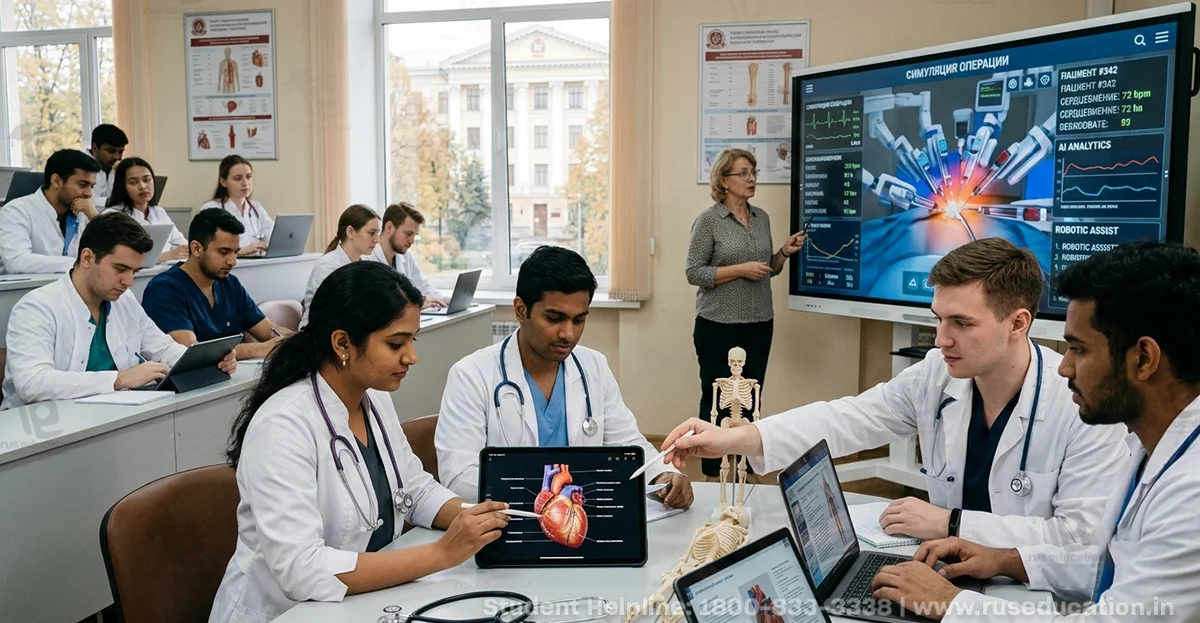
Digital learning in MBBS programs at Russian medical universities has expanded in recent years alongside classroom and hands-on training. Digital tools have significantly transformed medical education by shifting training toward interactive simulations, virtual clinical practice, and AI-driven diagnostics, while keeping hospital training as the foundation.
In this blog, we will discuss how digital tools are transforming medical education in Russia.
Students may use digital tools in medical education to access course materials, academic updates, assessment details, and to communicate with professors and faculty. However, clinical training will be entirely in person. MBBS aspirants in Russia must know how the system works at whichever university they are applying to beforehand to easily adjust to the coursework in the first semester.
Most Russian medical universities use digital tools that help students check grades and submit assignments, and offer discussion rooms for professors and students. Let’s take a look at different digital tools that are used by Russian medical universities for MBBS in Russia:
Most universities have digital libraries that provide access to e-textbooks and journals, along with reference material for MBBS studies. Students don’t have to purchase expensive textbooks or source them from another country.
Many universities record their lectures and upload them so students can access them for reference in the future. This helps students to study complex subjects like Biochemistry or Pharmacology, and they don’t have to rely on what they have noted down.
Many medical universities in Russia, like Orenburg State Medical University and Perm State Medical University, use AI-powered virtual patient scenarios and other virtual reality tools during clinical rotations to help students practice procedures and decision-making as well. This complements clinical training, not direct patient interaction.
Digital tools in MBBS studies are also used to track credits and test marks, as well as attendance. This helps students get a clear picture of their performance and how they are doing rather than waiting till the last minute for improvement.
Digital tool availability varies by university, which makes faculty usage inconsistent. The number of simulation lab resources also varies as per the institution.
The best approach is to check the digital tools offered at the university you want to shortlist for your MBBS studies before taking admission.
Digital tools do not replace lectures, seminars, or clinical rotations during MBBS in Russia; instead, it serves as an addition to them. Therefore, the traditional classroom teaching and hospital-based training remain unchanged.
Understanding and knowing a university’s digital infrastructure helps students set realistic expectations before starting their MBBS journey. Therefore, this becomes a crucial step before you actually reach the university.
If you are still waiting for a medical seat, contact us to know the admission process for MBBS in Russia at top medical universities. Call 1800-833-3338 to talk to our expert counselors.
Also Read: How Is AI Transforming Medical Education in 2026?
Q.1 Do Russian medical universities use digital learning tools?
Ans. Yes, most Russian universities use digital tools to provide access to course material, resources, assignments, and to check grades, as well as for faculty communication.
Q.2 Does digital learning replace clinical training during the MBBS program in Russia?
Ans. No, digital training cannot totally replace clinical training but supplements lectures and administrative work. Clinical rotations and hands-on training remain in-person.
Q.3 Do Russian medical universities record lectures for future reference?
Ans. Many universities record video lectures, though this depends on the university and faculty departments.
Q.4. Do Russian medical universities offer virtual simulation labs during MBBS in Russia?
Ans. Yes, many Russian medical universities, like Orenburg State Medical University and Perm State Medical University, offer virtual simulation labs to help students develop clinical skills.
Q.5 Are Russian medical universities NMC-compliant?
Ans. Yes, most Russian medical universities are NMC-compliant, making students eligible to practice in India after completion of their MBBS degree.