

August 4, 2026

Established in 1992, Rus Education is a proud reason of many who are currently living their dream and on the way to achieving their goal of becoming a doctor.

Medical education is rapidly evolving. In 2026, technology is not just supporting learning, but also how future doctors study and practice. The biggest reason behind this change is Artificial Intelligence (AI).
With AI, medical students can learn faster and smarter through Virtual Patient Simulation and a Personalised Learning System. Medical colleges, coaching centres, and other educational institutions have started using AI-powered tools to enhance the overall learning experience.
In this blog, we will delve into the role played by AI in medical education in 2026.
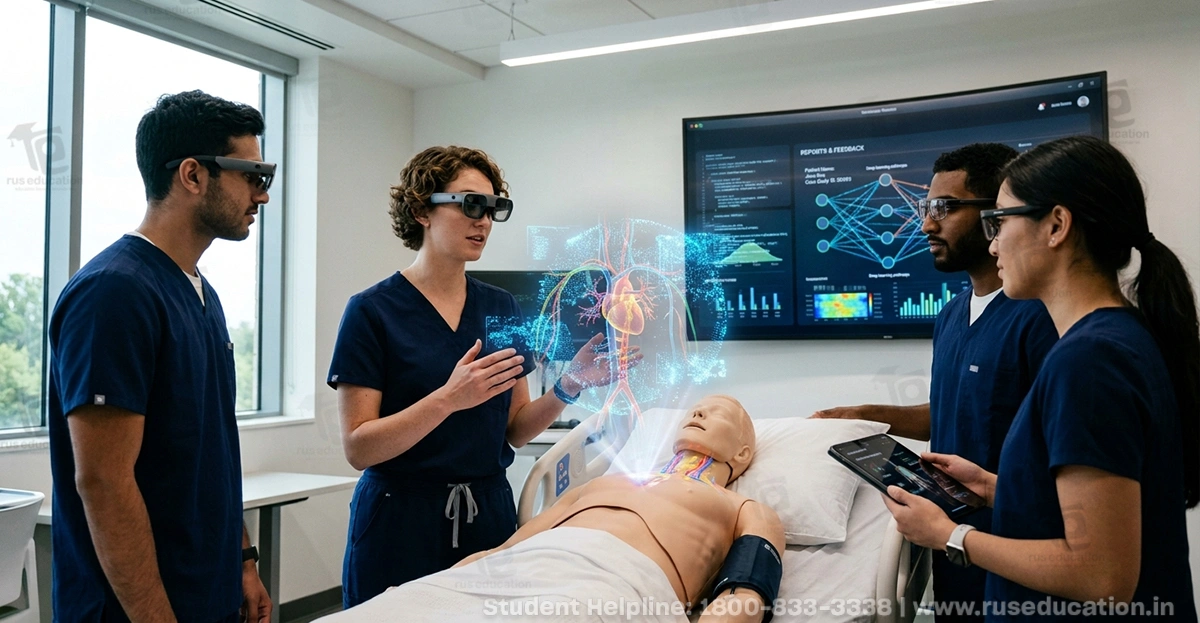
Clinical exposure has always been a challenge in medical education. However, students can now engage in clinical training using AI-powered virtual patient simulations and practice decision-making without risking patient safety.
This helps students:
These simulations act as real-time hospital scenarios and help students build confidence before doing real clinical practice.
Various medical colleges and universities are adopting the method of virtual simulations in their clinical rotations to offer safe learning experiences to students.
Every student is a different learner. Some students grasp concepts quickly, while others take time with more revision and practice. Several AI-based learning platforms provide personalized study experiences to solve this problem.
These platforms analyse student performance and speed, and identify weak areas, while evaluating practice test scores. The AI-powered platforms prepare customised learning plans based on this information. This makes learning less stressful and more effective.
Traditional exams take days and weeks to complete the evaluation process. AI has made it quicker and more accurate.
AI-powered tools can:
This feedback helps students instantly check their mistakes instead of waiting for days for results.
There are AI-powered mock test platforms that are getting increasingly popular among students preparing for NEET and FMGE exams.
AI Tutors are getting popular among medical students as they are available 24/7 as study assistants and to clear any doubts as well.
AI Tutors explain complex topics, create notes, generate practice questions and quizzes, and help students with time management. These become really useful in maintaining consistency and improving productivity.
It is tough to manually read every research paper. However, AI helps in this by summarizing research papers or medical journals while finding the most relevant ones. AI also helps in identifying the most up-to-date medical information for students and professionals.
Artificial Intelligence in medicine helps gather information more quickly rather than researching for hours, while saving time.
Through AI, medical students can also perform virtual surgeries, observe digital surgeries, and learn Anatomy in 3D.
This eliminates the fear many students experience initially during surgical training.
Though Artificial Intelligence offers many benefits, there are still some challenges associated with it.
1. Data Privacy
Patient and student data must be safe and protected.
2. High Cost of Implementation
Advanced AI systems are too expensive, and many institutions still struggle with them.
3. Technology Dependency
Human interaction and critical thinking may be reduced due to overdependence on technology.
4. Still a Need for Human Guidance
AI can support, but still can’t replace qualified doctors, mentors, and teachers. Human expertise and technology together generate the best results.
The future of medical education looks more interactive and digital. In the future, AI is expected to improve diagnostics, support faster research, increase accessibility, and create skilled medical professionals.
Adapting to the technology will provide an advantage to healthcare professionals.
AI has played a huge role in transforming medical education in 2026. From AI study platforms to virtual simulation, AI is helping future doctors prepare for real-world situations.
However, human intervention will always remain important. Clinical judgement, compassion, care, and communication cannot be replaced by Artificial Intelligence. AI is a powerful support system that can guide doctors, but teachers will continue mentoring students with their experience and expertise.
If you are a medical aspirant and wish to pursue MBBS in Russia, you can contact Rus Education for information about admission to top Russian medical universities.
Also Read: MBBS in Russia: Things To Consider For a Successful MBBS Journey
Q.1 What are some of the uses of AI in medical education?
Ans. Virtual Patient Simulation, Instant Feedback, and Personalised Learning System are some of the common uses of AI in medical education.
Q.2 Is AI used in medical universities of Russia?
Ans. Yes, most medical universities of Russia use AI-powered Virtual Patient Simulation during clinical rotations of MBBS students.
Q.3 Is AI replacing doctors in the field of medicine?
Ans. No, AI cannot replace doctors or human expertise in the field of medicine. Though AI can improve learning methods and practical training of medical students.
Q.4 Which Russian medical universities use AI-powered virtual patient simulation?
Ans. Orenburg State Medical University and Perm State Medical University are some of the top government universities that use AI-powered virtual patient simulation.
Q.5 What are the eligibility criteria for MBBS in Russia?
Ans. The eligibility criteria for MBBS in Russia are as follows:
1 Comment
Comments are closed.